Wednesday, 28 July 2021

Remote airport tarmac fall spotlights airline disembarkation accident liabilities

A serious accident during passenger disembarkation at a remote Australian airport demonstrates the relative safety responsibilities of airlines, ground handlers and airport operators to guard against foreseeable hazards.
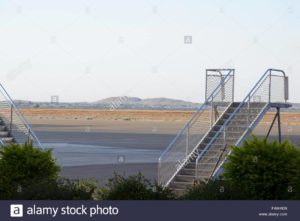
Airlines, ground handlers and airport operators all have responsibility for airline disembarkation accidentsIn November 2012 Ron Garnett – a fly-in/fly-out regular at that destination – made his way across the Karratha airport tarmac from the rear stairs of the Qantas B738 that had just arrived from Perth.

The sun had set 20 minutes earlier and daylight was fading fast. A path for arriving passengers leading to the terminal to the north of the tarmac was designated on the left side by bunting with flags strung between wheelie bins.

It joined a passenger walkway that ran east/west along the tarmac apron.

It was on that walkway as his left foot struck the unseen edge of a lighting tower plinth at its base, he fell smashing his left knee and causing other injuries.

His injury compensation lawsuit was begun in July 2014 against the carrier who subsequently joined as third parties its ground handling agent, Skystar and the aircraft owner and operator, Karratha City Council. The third parties cross claimed against each other.

In October 2015, Garnett was given leave to add Karratha and Skystar as defendants to his injury claim.

The four-way contest came before Judge Amanda Burrows SC in the District Court of Western Australia in May 2018.

Qantas conceded its liability as carrier for the disembarkation accident and agreed to pay Garnett $500k plus costs that being its maximum Civil Aviation (Carriers’ Liability) Act 1961 (WA) exposure for itself, its employees and agents as at the date of accident.

The contribution dispute then fell to be decided as between the carrier and Karratha & Skystar as did Garnett’s separate claims against those parties for his additional losses over and above the $500k limit.

Skystar separately agreed with Qantas to pay it 50% of the compensation and costs it was liable to pay the plaintiff Garnett.

The FIFO passenger alleged the non-carrier parties were liable to him for not having eliminated the hazard for example by painting the plinth in bright yellow, improving the lighting or installing a railing to isolate the hazard.

Garnett was able to make out his negligence claim and her Honour awarded him judgment for damages to be assessed as against Karratha.

The Council was also liable in Qantas’s contribution claim (for the other 50% of the sum it agreed to pay the passenger) due to its breach of a “safe access” term implied in the agreement for the use of the airport between it and the carrier.

It was however a different outcome as against Skystar who – as Qantas’s “agent” – was entitled to avail itself of the Carriers’ Liability Act two-year limitation period. On that interpretation, Garnett’s claim as against the ground handler had been “extinguished” before it had been joined as a defendant to the claim.

Garnett appealed the ruling that Skystar was Qantas’s “agent” for the purposes of the Carriers Liability Act.

Karratha also appealed that finding and the trial judge’s decision it had breached its duty of care to the passenger.

Both appeals were dismissed after they came before the WA Court of Appeal in May 2021.

The appellants alleged Skystar was not truly Qantas’s “agent” as it did not have the requisite authority to bind the carrier contractually. Rather – they contended – the ground handler was a mere subcontractor.

The appeal judges observed that various iterations of the international conventions which are applied domestically by Australian legislation clearly state that “a servant or agent of the carrier…. shall be entitled to avail themselves of the conditions and limits of liability which the carrier itself is entitled to invoke”.

They concluded the court should not focus on “the precise nature of the contractual relationship” but rather should identify “those entities and persons through which or by whom, the carrier provided the contracted service of carriage”.

“It is sufficient to conclude that the denotation of the phrase “servant or agent,” they wrote in the judgment of the Court, “includes an independent contractor engaged to marshal passengers from the aircraft to the terminal”.

In appealing the passenger’s judgement against it, Karratha had contended it had no responsibility for the injury because it played no part in designating the pathway that Skystar chose to utilise for the disembarking passengers.

That contention belied the unchallenged evidence. Only a few months earlier the Council had removed a grassed area delineating the plinth and replaced it with concrete to merge the area into the walkway. And its employees were “airside” daily and well aware of the plinth’s position in relation to the path Skystar had defined with wheelie bins and bunting.

“The judge was correct to find that the risk was reasonably foreseeable in that it was a risk of which Karratha knew or ought to have known”.

The assessment of Mr Garnett’s further damages payable to him for the disembarkation accident by Karratha City over and above that which Qantas must pay, will proceed in the coming months.

Garnett v Qantas Airways Ltd – [2021] WASCA 110, Murphy JA Mitchell JA Vaughan JA, 30 June 2021


source https://cartercapner.com.au/blog/remote-airport-tarmac-fall-spotlights-airline-disembarkation-accident-liabilities/


Friday, 9 July 2021

Global food giant in machinery fix fail; will pay $3 mil for factory worker injury

A factory worker has won substantial damages after being runover by runaway forklift that was serviced by its OEM supplier just 6 days earlier.

Employers must adequately maintain equipment to prevent factory worker injury Toufic Metri, – a licensed forklift operator – suffered extensive injuries after being ejected from the forklift he was driving at the Nestlé manufacturing facility in  Blacktown, NSW in August 2012.

The 44-yr-old Metri was working an extra shift moving pallets of incoming stock to racks identified by the computer screen on his forklift when it suddenly “took off” to a “crazy fast” speed which he had never before seen a forklift able to get to.

As he lifted his foot from the accelerator, instead of slowing, the machine kept getting faster until it suddenly decelerated and threw him onto the factory floor before it ran over his legs.

No longer able to work, Metri filed a lawsuit against Nestlé in 2015 for damages for the injuries including for economic loss and loss of future earning capacity.

He alleged Nestlé was required – pursuant to its own risk assessment recommendation – to have provided the forklift with seatbelts or other devices to prevent a factory worker injury by falling from it in case of any mishap or accident.

He also alleged the machine had been inadequately repaired after the prior and very similar mishap 6 days earlier.

With the leave of the Court in 2019, Metri added EOM Linde – the forklift manufacturer and the organisation with whom Nestlé contracted for the maintenance of its forklift fleet – as a second defendant on the ground it had negligently repaired forklift 432 after the earlier mishap.

Co-worker Jason Connell who had encountered a similar episode earlier that week had  “tagged” the machine out of service for a “speed sensor issue” and reported being startled by the malfunction the sudden unexplainable increase in speed to his supervisor.

Linde was requested to investigate. An experienced service technician repaired a fault he detected in the battery locking sensor and test-drove the machine for 20 minutes to confirm all safety features, plus the steering and brakes before returning the machine to service.

Regrettably, no specific investigation of the fault reported by Connell – an “overspeed issue – was carried out because those details had not been passed on by Nestlé to the Linde team.

The overspeed fault did not recur until Metri made use of the machine 3 days after its return to service.

The serious injuries Metri sustained included a “degloving” injury to his left lower leg which resulted in a below-knee amputation. A spinal injury aggravation, an avulsion fracture of his left elbow, PTSD and major depression that also resulted are permanent conditions.

Both the Defendants denied the allegations of negligence.

The trial came before Justice Christine Adamson in the NSW Supreme Court who concluded that the probability of the harm of a driver being ejected from a forklift in the event of a sudden change of movement must be regarded as “relatively low”.

She then considered a risk assessment conducted in 2008 that was reviewed in 2010 and 2012 and referred to the consequences of not using seatbelts on forklifts were that the “operator may fall out of forklift in the event of an incident /collision which can result in Injury/fatality”.

On that basis she ruled the likely seriousness of any resulting “harm” to be “very great” and the burden of taking reasonable precautions – seat belts or sidebars – “would not have been particularly expensive, difficult or impractical”.

The risk of injury was thus “material and foreseeable” and Nestlé was liable to Metri in negligence for having failed to take the requisite precautions as recommended in the risk assessment by installing seat belts or sidebars to minimise the risk to a driver.

Nestlé – by failing to adequately communicate Mr Connell’s description of the fault to the Linde service people – failed in its further duty to take reasonable care to maintain and repair equipment it provided its workers.

“The duty of care which Nestlé owed to him included a duty to obtain suitable equipment and take reasonable care to maintain and repair it”.

As against Linde, Metri simply pleaded res ipsa loquitur contending that the unresolved fault in forklift 432 was of itself evidence of the OEM’s failure to take reasonable care in conducting the repair.

That argument was rejected on the ground that information received by Linde was incomplete and lacked the specifics Connell had reported.

“The principle of res ipsa loquitur is inapposite,” ruled Judge Adamson.

Linde was not liable to Metri because it serviced forklift 432 and returned it to service without knowledge of the particular and rare overspeed problem which – had such information been provided to it – would have been investigated further.

Nestlé also failed in its cross-claim for indemnity against Linde for similar reasons.

The damages Nestlé – the world’s No 3 food production company – must pay him is $2.93 million and will include $400k for general damages, $444k for past expenses, loss of future earning capacity of $722k and future domestic assistance of $201k. The food giant was also ordered to pay the legal costs of Metri and Linde.

Metri v Nestlé Australia Ltd [2021] NSWSC 343, Adamson J, 7 April 2021 & 12 May 2021 Read case


source https://cartercapner.com.au/blog/nestle-pays-3-mil-for-factory-worker-injury/

Thursday, 8 July 2021

“Just and act” insurer says of victim; lashed by court for dismissing medical evidence

An Appeal court has ruled that evidence of “malingering and exaggeration” should not bar an accident victim who “exaggerated or feigned symptoms” from receiving substantial motor accident compensation for his injuries.

Insurers frequently claim that injury victims are exaggerating or malingeringKhaled Hoblos a 36yr-old Lebanese born bus driver walked away from the March 2015 collision that wrote off his car.

The at-fault party’s CTP insurer admitted liability for transient injuries to his left knee and foot.

It promptly stopped paying depression-related treatment expenses in February 2018 on receipt of a report from jointly appointed forensic psychiatrist Selwyn Smith that considered Hoblos to be “more likely than not” demonstrating “abnormal illness behaviour”.

The bus driver’s Sydney District Court compensation ask turned on the extent of any consequential psychiatric injury that three psychiatrists – Eddie So, Inglis Synnott (assessing impairment at 27%) and Robert Hampshire – had diagnosed as a major depressive illness.

Seizing on Dr Smith’s comments and those of orthopaedist Roger Rowe that there was no “pathological or radiological support for ongoing physical injury”, the insurer contended Hoblos had no compensable injury and that his presentation in court and to examining specialists had been “nothing but an act”.

Also persuaded by Dr Smith’s observation, trial judge Jonathon Priestley SC decided – in the absence of evidence as to what might cause a person to demonstrate abnormal illness behaviour – Hoblos was hyper-exaggerating and he and his partner were not at all credible witnesses.

The medical opinions that supported the debilitating depression diagnosis were disregarded by the judge as having no weight as they had been based on the claimant’s “unreliable and inconsistent accounts”.

Given the absence of ongoing physical injury, the resulting outcome was zero damages for Hoblos.

He filed an appeal arguing that exaggeration of symptoms should not of itself invalidate the several diagnoses of his severe mental illness.

The NSW Court of Appeal – without disturbing the primary judge’s findings that the plaintiff had exaggerated or feigned symptoms – agreed.

In separate judgments, Justices Richard White and Lucy McCallum reasoned there was no basis for the assumptions that the trial judge had made.

“People with major depression [can] give a presentation and account of difficulties which can be exaggerated or feigned,” wrote Justice White. “A person with a major depressive disorder might display abnormal illness behaviour at the same or at a later point in time”. He noted that such behaviour may indeed be a symptom of the underlying condition.

The insurer’s case that the two conditions were mutually exclusive relied on flawed logic and a “false dichotomy”, observed Justice McCalum, resulting in an hypothesis that was “as farfetched as it is improbable”.

Noting that its video surveillance produced nothing significant, she observed that the insurer’s argument would require the court to find Hoblos’ illness behaviour was a sham “only because he played it too well”.

While the inconsistencies, exaggeration and even “abnormal illness behaviour” might have made the assessment of damages more difficult, it was the trial judge’s duty to have assessed them and not “conflate” liability issues with damages.

“The law is clear that his Honour should have proceeded to quantify damages, however difficult that task may have been,” wrote Justice McCallum.

“Lawyers should be wary of dismissing medical assessments,” she pondered on the insurer’s case theory, “where they are reached bringing to bear clinical experience and medical expertise”.

The appeal court held that the plaintiff was suffering from major depressive disorder and that the plaintiff should be entitled to all consequential losses including loss of income etc.

The appeal judges allowed the parties 28 days to lead arguments as to whether the damages should be re-assessed – as is the usual case – by the trial court or assessed by the appellate court on the available evidence as the cost of remittal to district court would be “disproportionate to the interest at stake”.

Hoblos v Alexakis, [2021] NSWCA 126, White JA, McCallum JA and Davies J, 23 June 2021 Read case


source https://cartercapner.com.au/blog/just-and-act-insurer-says-of-victim-lashed-by-court-for-dismissing-medical-evidence/

Wednesday, 7 July 2021

Receptionist’s $120k fall in rush to answer call: should boss have provided a $220 headset?

A suburban office worker has argued for substantial damages in a case filed against her employer for an ankle injury sustained in a fall when rushing to answer an incoming call.

office worker gets payout for injury running for phoneDaina Michel – an office manager for cleaning company Broadlex Services – was required to answer incoming calls on the landline phone maintained at her reception desk in addition to managing the front and rear storage rooms and other duties that took her away from the desk.

In January 2015, when Daina was in the back storeroom of the Fyshwick premises in Canberra organising the uniform cupboard in the storeroom, the phone rang in.

As always, she ‘rushed’ to answer it but this time – as she got past her chair and leaned over the desk awkwardly to pick up the phone – her ankle rolled causing serious injury.

She sued her employer in the A.C.T. Magistrates Court alleging her exposure to “a risk of injury when moving from some other place to pick up her phone” and “that a reasonable employer would have taken the precaution of providing her a cordless headset”.

Daina had on two occasions requested such a device to monitor calls while simultaneously performing her away-from-desk duties. Her request was repeatedly denied by branch manager Mike Todoroski on the grounds it would not be approved by head office because they “weren’t getting enough calls to warrant a headset”.

Magistrate Peter Morrison accepted that answering the phone was an important part of Daina’s role and that she had been reprimanded for not answering calls which if unanswered were diverted to head office in Sydney.

Broadlex defended by asserting that although the risk of injury to Ms Michel in answering the phone was foreseeable, it was “insignificant”, and that a reasonable employer would not have taken the precautions Daina contended for.

The provisions of the Civil Law (Wrongs) Act (ACT) relied on by the employer to deny liability are identical to those in ss 9 (1)(b) & (c) of Queensland’s Civil Liability Act.

Important to the employer’s argument was that the office averaged, just 5 incoming calls per day.

Noting the number of incoming calls being low, his Honour directed his attention to the frequency of the “overlap” of incoming calls while away from her desk and decided the instances of having to rush back were “not frequent but were not uncommon”.

On the first issue of contention, his Honour found in Daina’s favour in deciding that “though the threshold of the risk of harm to Ms Michel was not great, on balance, it was not so low  as to be properly described as insignificant”.

As to the second issue he accepted the employer’s argument that evidence as to the cost of such a headset was “limited” but ruled “it is common knowledge in the current age that such commonplace electronic communication items are inexpensive”.

Daina had brought the need for the equipment to her manager’s attention her request was turned down despite knowledge of the circumstances giving rise to the risk of such injury from moving quickly around the office ‘on reasonably frequent basis’.

“A reasonable person in the defendant’s position would have taken the precaution of providing a headset to enable her to answer the phone while away from her usual desk at reception. The burden on the employer of taking the precaution identified was minimal”.

But as to causation, the injury had occurred as she “was leaning around and in an awkward position picking up the phone” and not while “rushing to the phone”.

Broadlex insisted – in a submission based on the ACT equivalent of s 11 (1)(a) of Queensland’s Civil Liability Act – that any negligence on its part could thus not have been “a necessary condition of the occurrence of the harm” Daina sustained.

She could after all, just as easily injured herself by reaching over or around the chair to pick up a pen or to do something on a computer or to pick up a piece of paper.

Not so ruled the court.

Having to quickly navigate past the chair and lean in and around was “integrally connected” to the rushing to answer the phone which would have been avoided by the provision of a wireless headset.

The court ultimately awarded judgement for the plaintiff in the amount of the agreed damages, $119k.

Michel v Broadlex Services Pty Ltd [2020] ACTMC 27, 11 December 2020


source https://cartercapner.com.au/blog/office-worker-injury-when-running-for-phone-yields-120k/

Full steam ahead for river cruise disappointment damages

The New South Wales Court of Appeal yesterday delivered the final test case ruling relating to the 2014 Rhine River cruise disruption and di...